
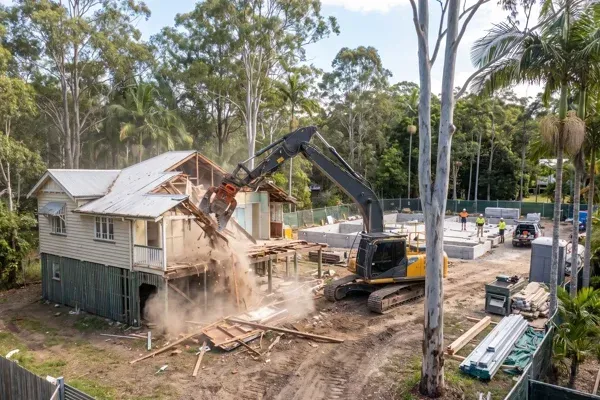
Knockdown-Rebuild on the Gold Coast: Tear Down and Build New
By Lior Golan, Founder, Prestige Custom Building & Construction. Last updated July 2026.
Drive through Old Westbury, Sands Point, or Cold Spring Harbor and you’ll notice something. Some of the most valuable land on Long Island’s Gold Coast sits under homes that were built for a different era. Dated floor plans, tired mechanicals, low ceilings, and layouts that fight the way families actually live today. The lots are extraordinary. The houses on them, often, are not.
That gap is exactly where the knockdown-rebuild play lives. For many high-net-worth buyers on the North Shore, the smartest move isn’t buying a finished home or renovating a compromised one. It’s buying an older house on a prime lot, tearing it down, and building new from the ground up. Done right, you get the location you wanted and a home designed for the next 30 years. This guide walks through when a knockdown rebuild long island project beats renovating, the process step by step, what to check before you buy a tear-down, and the real cost and timeline you should plan around.
Key Takeaways
- On the Gold Coast, the land often carries the value. Nassau County’s median single-family price reached $835,000 in early 2026 (Molloy University / OneKey MLS, 2026), so a dated house on a great lot is frequently a rebuild candidate, not a keeper.
- New construction gives you a fresh foundation, modern systems, and a design built around how you live. The average new single-family home cost about $162 per square foot to construct nationally, with custom builds higher (NAHB, 2024).
- Due diligence comes before demolition. New York’s 2025 freshwater wetlands rules expanded state jurisdiction by roughly a million acres (Lippes Mathias LLP, 2025), so wetlands, setbacks, and utilities can make or break a tear-down before you close.
- A knockdown rebuild is a design-build project, not a purchase. Feasibility, approvals, demolition, and construction all need to be sequenced by one team that owns the outcome.
What is a knockdown rebuild, and why is it so common on the Gold Coast?
A knockdown rebuild means buying an existing home, demolishing it, and constructing a brand-new house on the same lot. It’s common here because the land does the heavy lifting. Nassau’s median single-family sale price reached $835,000 (Molloy University / OneKey MLS, 2026), and much of that value lives in the parcel, not the aging structure on it.
The Gold Coast is full of estate lots that were subdivided and built out decades ago. You can’t manufacture more of Kings Point’s waterfront or Lloyd Harbor’s wooded acreage. So when a family wants a specific town, a specific school district, or a specific view, the house that happens to sit there is often beside the point. The lot is the asset. The building is a placeholder waiting to be replaced.
When does a knockdown rebuild beat renovating?
Renovation makes sense when the existing structure is fundamentally sound and you like the bones. A rebuild wins when the foundation, footprint, or systems can’t support the home you actually want. If you’re gutting to the studs, moving load-bearing walls, and replacing every mechanical system anyway, you’re often paying renovation prices for a compromised result.
Here’s the honest comparison we walk clients through:
| Factor | Knockdown Rebuild | Major Renovation |
|---|---|---|
| Starting point | Clean slate, new foundation | Existing frame and footprint |
| Design freedom | Full control of layout, ceilings, systems | Constrained by what’s already there |
| Systems | All-new electrical, plumbing, HVAC, insulation | Mix of new and legacy, hidden surprises |
| Cost predictability | Higher upfront, fewer unknowns once built | Lower entry, more mid-project surprises |
| Timeline | Longer overall (demo + full build) | Shorter if scope stays contained |
| Best when | Structure is dated or maldesigned; lot is the value | Bones are sound; you like the existing layout |
The tipping point is usually this. Once a renovation’s scope creeps past roughly half the home’s structure, the cost gap narrows and new construction starts to deliver far more value for the money. Our renovations team and our custom homes team assess the same property honestly and tell you which path fits. For a deeper look at the trade-offs, our buy-vs-build comparison breaks down the numbers side by side.
What does the knockdown rebuild process actually look like?
The process moves through four sequenced phases: feasibility, approvals and demolition, construction, and closeout. Because national new-home construction averaged about $162 per square foot (NAHB, 2024) and custom Gold Coast builds run well above that, getting the sequence right protects both your budget and your timeline.
| Phase | What Happens | Typical Focus |
|---|---|---|
| 1. Feasibility | Site study, zoning and setback review, survey, soil and utility checks | Can you build what you want here? |
| 2. Approvals & Demolition | Permits, variances if needed, utility disconnects, demolition | Clearing the path, literally and legally |
| 3. Construction | Foundation, framing, systems, exterior, interior finishes | Building the home to spec |
| 4. Closeout | Final inspections, certificate of occupancy, landscaping, walkthrough | Handing you the keys |
The single biggest mistake buyers make is treating these as separate vendors. When feasibility, architecture by our licensed architect partners and construction are managed as one design-build process, problems get caught on paper instead of in the field. Our portfolio shows what that integrated approach produces.
What should you check before buying a tear-down?
Before you close, confirm four things: zoning and setbacks, wetlands, utilities, and buildable envelope. This matters more than ever. As of January 2025, New York expanded state wetlands jurisdiction by roughly a million acres (Lippes Mathias LLP, 2025), and DEC typically regulates a 100-foot adjacent buffer around protected wetlands.
Zoning and setbacks determine how big a home you can legally build and where it can sit. Many Gold Coast lots carry generous minimums, but front, side, and rear setbacks, plus height and coverage limits, shape the real buildable envelope. Wetlands, watercourses, and coastal areas add another layer of state and local review. Utilities matter too: an older home may have an undersized service, a failing septic system, or well water where you assumed municipal supply. And the survey tells you whether the lot’s usable area actually fits your program.
Would you buy a business without reading its books? A tear-down is the same. Confirm every one of these specifics with the local building department and, where relevant, NYSDEC before you commit. Our Long Island permit process guide explains what to expect once you’re through diligence and into approvals.
How much does a knockdown rebuild cost on the Gold Coast?
Expect luxury Gold Coast rebuilds to run well above national averages. Nationally, the average new single-family home cost about $162 per square foot to construct, a record high, with custom and contractor-built homes at a median near $166 (NAHB, 2024). Custom homes on the North Shore, with premium finishes and demanding sites, sit meaningfully higher.
Your total budget has three moving parts: acquisition, demolition and site work, and construction. Demolition of a single-family home, including debris removal and permits, commonly runs from roughly $8,000 to $25,000, and site preparation, grading, and utility work add more depending on conditions (Block Renovation, 2025). On a prime lot where land is the dominant cost, the acquisition often dwarfs the build. That’s the whole logic of the play: you’re paying for location, then putting up a home worth the address. Our cost-to-build guide walks through the line items in detail.
How long does a knockdown rebuild take?
Plan for a multi-phase timeline measured in months, not weeks. Feasibility and approvals typically take the longest to predict, because permit and variance timelines vary by town, and wetlands or coastal review can add significant time. New York’s updated 2025 wetlands framework introduced parcel-focused jurisdictional determinations that must be resolved before certain projects proceed (Lippes Mathias LLP, 2025).
Once permits are in hand, demolition is fast, often a matter of days. Construction is the long pole: foundation, framing, systems, and finishes for a custom home unfold over many months. The realistic way to think about it is that most of your calendar risk lives before the first shovel, in diligence and approvals, which is exactly why an experienced local builder who knows each town’s building department earns their keep early.
What’s the value upside of building new?
The upside is a home built to today’s standards on land that only appreciates. Long Island’s market has stayed strong even through rate volatility, with Nassau’s median single-family price reaching $835,000 (Molloy University / OneKey MLS, 2026), and much of that value tied to the land itself.
A new build gives you energy-efficient systems, a layout designed around your family, and none of the deferred maintenance that haunts older estates. On the Gold Coast, where buyers pay for the address and the experience, a thoughtfully designed new home on a prime lot is one of the clearest value stories in the region. You’re not just replacing a house. You’re unlocking what the land was always worth.
Before you break ground, download our free custom home planning guide, drawn from more than 30 years and over 100 custom homes and renovations across the North Shore. When you’re ready to talk specifics, schedule a consultation with our team, and we’ll tell you honestly whether your lot is a rebuild candidate.
Frequently Asked Questions
Is it cheaper to knock down and rebuild or renovate?
It depends on scope. Light renovations are cheaper, but once you’re gutting to the studs and replacing systems, new construction often delivers more value. National new-home construction averaged about $162 per square foot, a record high (NAHB, 2024). Compare total cost against outcome, not entry price alone.
Do I need special permits to demolish a house on Long Island?
Yes. Demolition requires local permits, utility disconnects, and often environmental review, and costs commonly land in the range of $8,000 to $25,000 (Block Renovation, 2025). Wetlands, asbestos, and coastal rules can add steps. Always confirm requirements with your local building department and NYSDEC before scheduling any demolition work.
How do wetlands affect a tear-down purchase?
Significantly. New York’s 2025 rules expanded state wetlands jurisdiction by roughly a million acres, with a regulated buffer generally around 100 feet (Lippes Mathias LLP, 2025). Wetlands can shrink your buildable envelope or block a project entirely, so confirm status via a jurisdictional determination before you buy.
Why are Gold Coast lots worth more than the homes on them?
Because land is finite and location is priceless here. Nassau’s median single-family price reached $835,000 (Molloy University / OneKey MLS, 2026), much of it tied to the parcel. Dated estates on prime lots in towns like Sands Point or Cold Spring Harbor are frequently worth more torn down and rebuilt.
How long does the whole knockdown rebuild process take?
Plan for many months across feasibility, approvals, demolition, and construction. Approvals are the least predictable phase, since 2025 wetlands rules added parcel-level jurisdictional determinations to some timelines (Lippes Mathias LLP, 2025). A local builder who knows each town’s process keeps the calendar moving.
Architectural and design services are provided by independently licensed architects. Prestige Custom Building & Construction, Inc. is a licensed home-improvement/construction company and is not a licensed architecture firm.
Lior Golan is the founder of Prestige Custom Building & Construction, a custom home builder serving Long Island’s Gold Coast and the Hamptons. Over more than 30 years he has guided over 100 custom homes and renovations across the North Shore, from Roslyn and Sands Point to Cold Spring Harbor.

