
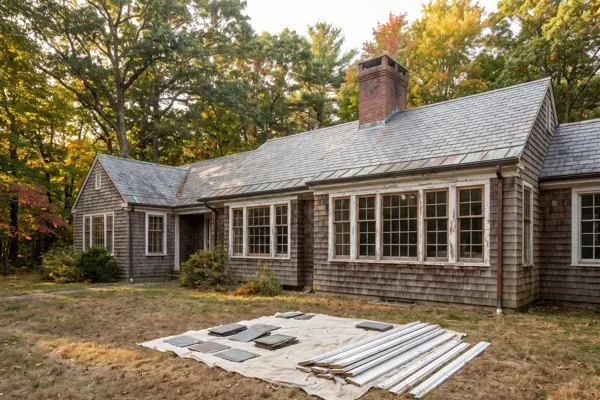
Restoring an Older Home on the North Shore: Keep or Replace
By Lior Golan, Founder, Prestige Custom Building & Construction. Last updated October 2026.
Restoring an older home on Long Island’s North Shore comes down to one question, asked room by room and system by system: what do you keep? Original plaster, a staircase, wood windows and a slate roof can be worth saving. Knob-and-tube wiring, rusted supply pipe and a buried oil tank almost never are.
This post starts after the decision to renovate. Many homeowners who reach out to us are still weighing whether to renovate, add on or tear down; knockdown-rebuild on the Gold Coast covers that fork, and deciding whether to renovate or sell and buy covers whether to stay at all.
Key Takeaways
- Most home heating oil tanks fall outside New York’s Petroleum Bulk Storage rules because they hold less than 1,100 gallons, but county rules may apply in Nassau and Suffolk (NYSDEC).
- A properly installed slate roof lasts 60 to 125 years or longer (NPS Preservation Brief 29, 1993).
- HUD puts the service life of galvanized steel water piping at 20 to 50 years and says knob-and-tube wiring should be replaced during rehabilitation (HUD, 2000).
- New York’s energy code applies to the parts of the house you alter, not the parts you leave alone (2025 ECCCNYS, 2025).
Which Original Features Are Worth Keeping in an Older North Shore House?
Usually the ones that are hardest to reproduce: plaster, original millwork and stairs, wood windows, slate or clay tile roofs, and brick or stone. For historic buildings, the federal Standards for Rehabilitation say deteriorated features “shall be repaired rather than replaced” unless the damage requires replacement, and that distinctive craftsmanship should be preserved (National Park Service, 2026).
Plaster. It was the wall surface in nearly all buildings until the 1930s or 40s. The Park Service notes that 3-coat plaster resists fire and reduces sound transmission, and that plaster “is often not as badly damaged as it first appears” (NPS Preservation Brief 21, 1989).
Millwork and stairs. A staircase, paneling and original trim are the kind of craftsmanship the Standards say should be preserved, and the pieces a new house can’t give you. Plan the new layout around them.
Windows and roofs. The Park Service recommends exterior storm windows because they are “thermally efficient, cost-effective, reversible, and allow the retention of original windows” (NPS Preservation Brief 9, 1981). Clay tile has one of the longest life expectancies of any historic roofing, generally about 100 years (NPS Preservation Brief 30, 1993).
| Element | Keep it when | Replace it when |
|---|---|---|
| Plaster walls and ceilings | Loose areas can be reattached to the lath and the plaster around them is sound | It can’t be repaired; the Park Service’s option is a veneer plaster system |
| Wood windows | Sash and frames can be repaired, with a storm window added | The window’s condition clearly calls for replacement |
| Slate roof | The slate is sound and the failure is in the nails or flashings | The slate itself is at the end of its service life |
| Knob-and-tube wiring | It’s properly installed, needs no modification, is grounded, has adequate capacity and no failed insulation, and is otherwise in good condition (HUD: it can be acceptable) | HUD’s default: replace it during rehabilitation |
| Galvanized steel water pipe | The work doesn’t expose it and flow and pressure are still good | It’s exposed during rehabilitation (HUD’s advice: consider replacing it) |
New York requires an asbestos survey before renovation work, with plaster on its list of suspect materials (NYS Department of Labor, 2026), and EPA’s lead rule covers anyone paid to disturb paint in a pre-1978 house (U.S. EPA, 2026); for the cost side, see the cost to gut and renovate a house on Long Island.
What Almost Always Has to Be Replaced When Restoring an Older Home?
The systems behind the walls and any buried oil tank. HUD’s rehabilitation guide says knob-and-tube wiring “should be replaced during rehabilitation” and puts galvanized steel piping’s service life at 20 to 50 years (HUD, 2000).
- Knob-and-tube wiring. HUD’s 2000 guide says it was still found fairly often in houses built before 1930, and its insulation “turns dry and brittle with age.”
- Galvanized steel supply pipe. Rust and mineral deposits cut flow and pressure. HUD says to consider replacing it where it’s exposed.
- A buried heating oil tank. See the next section.
- Framing that can’t carry the new layout. HUD notes that in older buildings, walls or columns supporting the floor above may have been removed in an earlier alteration (HUD, 2000). An engineer checks the structure against your new plan.
For what the work costs, see the cost to gut and renovate a house on Long Island. How a Prestige renovation works is on our home renovations page.
What Should You Know About a Buried Oil Tank?
That New York’s bulk storage rules probably don’t cover it, your county’s rules may, and DEC calls removal the best choice. Most home heating oil tanks fall outside New York’s Petroleum Bulk Storage rules because they hold less than 1,100 gallons, but in Nassau and Suffolk, DEC tells homeowners to ask the county Department of Health whether smaller tanks are regulated (NYSDEC).
DEC notes that many buried home tanks are like the 275-gallon steel tanks you see in basements, which “were not designed to be buried” and, left in place, “will eventually corrode and leak.” Signs include a damaged tank or pipe and stained or oil-smelling soil (NYSDEC).
State law requires a tank to be emptied, cleaned and purged of vapors, whether it’s closed in place (filled with an inert material such as sand) or removed. DEC says “The best choice is to remove the tank,” because you can check the soil for contamination and avoid a future sinkhole. It adds that if you sell, a bank or buyer will likely ask for an environmental assessment or the tank’s removal (NYSDEC).
Your village may add a step. In Manorhaven, the building department must issue a written permit before a fuel oil tank is removed, and abandoned tanks are handled under the Nassau County Fire Prevention Ordinance (Village of Manorhaven Code). Ask your building department before anyone digs.
If a leak turns up, it has to be reported to the NYS Spill Hotline, and the property owner is among those required to report (NYSDEC). DEC also warns that many homeowner’s policies carry a “pollution exclusion” clause, which can leave the cleanup bill with you (NYSDEC). Read your policy, and talk to your attorney if contamination is found.
Settle the tank early.
Comparing builders for the work? Our free Custom Home Building Guide includes 12 questions to ask any builder.
How Do You Bring an Older House Up to Code Without Losing Its Character?
Under New York’s energy code, the new work has to meet the code and the parts you leave alone don’t, and a historic house can get more room. The 2025 code applies new-construction requirements to alterations “without requiring the unaltered portions of the existing building” to comply (2025 ECCCNYS, 2025). It has applied to building permit applications since December 31, 2025 (NY Department of State).
A house that qualifies as historic, such as one on the National or State Register or designated under local law (2025 ECCCNYS definitions, 2025), gets more room: compliance isn’t required for features covered by a historic building report the building official approves. That report must show that meeting a specific provision would threaten, degrade or destroy the building’s historic form, fabric or function (2025 ECCCNYS, 2025).
Other codes reach further: under New York’s residential code, a permitted alteration means smoke alarms where a new house would need them, unless the work is only exterior, plumbing or mechanical (2025 RCNYS, 2025).
Deciding what stays, and drawing the new work around it, is design work. On our renovations, the architecture is performed by our licensed architect partners, and we coordinate it with the build; our interior architecture page shows how. If the house sits in a mapped flood zone, read building in a flood zone on the North Shore before you set the scope.
Is the House in a Historic District?
Check the State and National Registers and any local landmark designation separately; they work differently. New York’s State Historic Preservation Office says private owners of State and National Register properties who use private funds may alter them, subject to local rules, but projects involving federal or state funding or permits, such as a DEC permit, are reviewed by its staff (NY State Historic Preservation Office).
Many New York communities have landmark ordinances with commissions that review work on locally designated properties, and their districts often differ from the Register’s (NY SHPO). The Park Service calls the Secretary of the Interior’s Standards “the Standards most often used by local historic district commissions nationwide” (National Park Service, 2026).
Ask your building department whether the house or street is designated before design starts. Exterior design review is covered in architectural review board approval on the North Shore, and the sequence of filings in the Long Island custom-home permit and approvals process.
How Do You Plan Preservation Into a Whole-Home Renovation?
Decide what stays before the design is finished, then put it in the drawings and the budget. In a historic home renovation, the Standards give a useful order: keep what defines the house, repair what’s worn, and where something must be replaced, match the old in design, color and texture (National Park Service, 2026).
- Inventory. List the original elements room by room with their condition, and get the required testing and any tank investigation done early.
- Decide. With your architect, mark each item keep, repair or replace.
- Price. Our renovations start from $500K, typically $380-430 per square foot, all-in. You walk through the renovated house in photorealistic 3D, and your budget is set before construction begins.
- Protect. Write into the scope how the stairs, floors, plaster and windows you’re keeping will be protected during demolition.
Our process lays out each stage, how to prepare for a whole-house renovation covers your household, and our portfolio shows finished work; luxury home renovation ideas helps with the new rooms.
Frequently Asked Questions
Is it worth repairing an original slate roof?
Often, yes. The Park Service puts a properly installed slate roof’s life at 60 to 125 years or longer, and notes that metal flashings often wear out before the slate does (NPS Preservation Brief 29, 1993). Where nails or flashings caused the failure, it says salvaging at least some slates should be possible.
Can knob-and-tube wiring stay in a renovated house?
Sometimes, but HUD’s 2000 rehabilitation guide says it should be replaced during rehabilitation. It adds that it can be an acceptable system if it’s properly installed, needs no modification, is grounded, has adequate capacity, has no failed insulation and is otherwise in good condition (HUD, 2000). Ask your building department whether it’s allowed, and check whether your insurance policy excludes it.
Who has to report a heating oil leak in New York?
The property owner, among others. DEC says the responsible party or the property owner is required to report the discovery of a release, by calling the NYS Spill Hotline at 1-800-457-7362 (NYSDEC). Petroleum spills must be reported within 2 hours of discovery, apart from a narrow small-spill exception.
What mortar should be used to repoint old brick or stone?
A soft one. The Park Service says repointing mortar should be softer or more permeable than the brick or stone, and no harder than the historic mortar, to prevent damage to the masonry. It calls it a common error to assume hardness or high strength makes a mortar appropriate (NPS Preservation Brief 2, 1998).
Can you keep original windows under New York’s energy code?
Yes. Windows you leave unaltered don’t have to comply, and the 2025 code doesn’t require storm windows installed over existing windows, or glass-only replacements in an existing sash and frame, to meet its alteration requirements, provided the building’s energy use doesn’t increase (2025 ECCCNYS, 2025).
If you’re restoring an older home on the North Shore, book a consultation and bring your property survey, any old drawings and the heating system records. You’ll talk with me directly. I’ve spent 30+ years building on Long Island, with 100+ homes built and renovated, and we take on only 5-6 projects a year.
Architectural and design services are provided by independently licensed architects. Prestige Custom Building & Construction, Inc. is a licensed home-improvement/construction company and is not a licensed architecture firm.
Lior Golan is the founder of Prestige Custom Building & Construction, a custom home builder serving Long Island’s Gold Coast and the Hamptons. Over more than 30 years he has guided over 100 custom homes and renovations across the North Shore, from Roslyn and Sands Point to Cold Spring Harbor.

